import logging, warnings
from pathlib import Path
warnings.filterwarnings('ignore')
logging.disable(logging.CRITICAL)   # silence parse-unit notices; see prose below

import pandas as pd
import prosodicProse rhythm
Is prose measurably less metrical than verse? The cadence question, answered inside prosodic
Verse announces its rhythm; prose merely has one. Whether that prose rhythm is measurable — whether Sir Thomas Browne’s cadences or Lincoln’s periods differ quantifiably from Shakespeare’s pentameter — was the research question behind cadence, a fork of prosodic built to scan prose (archived 2026, its capabilities absorbed into prosodic v3). This page asks cadence’s question with prosodic’s tools: the same exhaustive metrical parser, phrase-sized parse units, and the phrasal-stress machinery described in the phrasal stress methods page. Every output below is computed by the code shown.
The prose passages (Melville 1851, Browne 1658, Lincoln 1863)
MOBY = ("Call me Ishmael. Some years ago—never mind how long precisely—having "
"little or no money in my purse, and nothing particular to interest me on shore, "
"I thought I would sail about a little and see the watery part of the world. It "
"is a way I have of driving off the spleen, and regulating the circulation. "
"Whenever I find myself growing grim about the mouth; whenever it is a damp, "
"drizzly November in my soul; whenever I find myself involuntarily pausing "
"before coffin warehouses, and bringing up the rear of every funeral I meet; "
"and especially whenever my hypos get such an upper hand of me, that it requires "
"a strong moral principle to prevent me from deliberately stepping into the "
"street, and methodically knocking people's hats off—then, I account it high "
"time to get to sea as soon as I can. There now is your insular city of the "
"Manhattoes, belted round by wharves as Indian isles by coral reefs—commerce "
"surrounds it with her surf. Right and left, the streets take you waterward. "
"Its extreme downtown is the battery, where that noble mole is washed by waves, "
"and cooled by breezes, which a few hours previous were out of sight of land. "
"Look at the crowds of water-gazers there.")

URN = ("What song the Sirens sang, or what name Achilles assumed when he hid "
"himself among women, though puzzling questions, are not beyond all conjecture. "
"Life is a pure flame, and we live by an invisible sun within us. The night of "
"time far surpasseth the day, and who knows when was the equinox? Darkness and "
"light divide the course of time, and oblivion shares with memory a great part "
"even of our living beings. But the iniquity of oblivion blindly scattereth her "
"poppy, and deals with the memory of men without distinction to merit of "
"perpetuity. Who can but pity the founder of the pyramids? Herostratus lives "
"that burnt the temple of Diana, he is almost lost that built it. Time hath "
"spared the epitaph of Adrian's horse, confounded that of himself. The greater "
"part must be content to be as though they had not been, to be found in the "
"register of God, not in the record of man.")

GETTYSBURG = ("Four score and seven years ago our fathers brought forth on this "
"continent, a new nation, conceived in Liberty, and dedicated to the proposition "
"that all men are created equal. Now we are engaged in a great civil war, "
"testing whether that nation, or any nation so conceived and so dedicated, can "
"long endure. We are met on a great battle-field of that war. We have come to "
"dedicate a portion of that field, as a final resting place for those who here "
"gave their lives that that nation might live. It is altogether fitting and "
"proper that we should do this. But, in a larger sense, we can not dedicate—we "
"can not consecrate—we can not hallow—this ground. The brave men, living and "
"dead, who struggled here, have consecrated it, far above our poor power to add "
"or detract. The world will little note, nor long remember what we say here, "
"but it can never forget what they did here. It is for us the living, rather, "
"to be dedicated here to the unfinished work which they who fought here have "
"thus far so nobly advanced. It is rather for us to be here dedicated to the "
"great task remaining before us—that from these honored dead we take increased "
"devotion to that cause for which they gave the last full measure of "
"devotion—that we here highly resolve that these dead shall not have died in "
"vain—that this nation, under God, shall have a new birth of freedom—and that "
"government of the people, by the people, for the people, shall not perish "
"from the earth.")
Prose parses too
Verse hands the parser its unit: the line. Prose has no lines, so prosodic scans it in lineparts — the phrase-sized stretches between punctuation marks (Meter(parse_unit='linepart')). The opening of Moby-Dick:
moby = prosodic.Text(MOBY)
moby.parse(meter=prosodic.Meter(parse_unit='linepart'))

for lp in moby.lineparts[:6]:
    try:
        bp = lp.best_parse
        print(f"{bp.meter_str:16s} score={bp.score:.0f}  | {bp.txt}")
    except AssertionError:
        words = ' '.join(w.txt.strip() for w in lp if not w.is_punc)
        print(f"{'(not parsed)':16s}           | {words[:52]}…")
+-+- score=0 | CALL me I shmael
-+-+ score=0 | some YEARS a GO
+-+-+-+- score=0 | NE ver MIND how LONG pre CI sely
+-+-+-+-+-+ score=2 | HA ving LIT tle OR no MO ney IN my PURSE
-+-++-+-+-+-+ score=2 | and NO thing PAR.TI cu LAR to IN terest ME on SHORE
(not parsed) | I thought I would sail about a little and see the wa…Call me Ishmael scans as two clean trochees — the most famous opening in American prose is perfectly, if invertedly, metrical — and the next two phrases are flawless iambic runs. One clause in this batch goes unparsed: at 19 syllables it exceeds MAX_SYLL_IN_PARSE_UNIT (18), the cap that keeps exhaustive candidate generation affordable. (The web app sub-splits such clauses at dependency-tree boundaries when syntax=True; here we simply skip them and say so.)
The grid on prose
Sir Thomas Browne’s Urn Burial (1658) is the canonical example of cadenced English prose. With syntax=True, the Hayes-style grid stacks phrasal prominence above lexical stress — the sentence’s nuclear stress becomes the tallest column:
browne = prosodic.Text(
    "Life is a pure flame, and we live by an invisible sun within us.",
    syntax=True)
browne.parse()
print(browne.line1.grid_str())
*
* * * * * *
* * * * * * *
* * * * * * *
* * * * * * * * * * * * * * * * * *
LIFE is a PURE FLAME and we LIVE by AN in VI si ble SUN wi THIN us
s w w s* s* w w s w s* w s w* w* s w s wThe grid’s phrasal rows are computed from three word-level columns — gradient phrase strength (pstress), cumulative sentence prominence (tstress, min–max normalized so 1.0 is the nuclear stress), and pstrength, which marks local phrasal peaks and valleys (1 = more prominent than both neighbors, 0 = less; the newest member of the family, completing the cadence constraint set):
df = browne.df
(df[df.form_idx == 0].drop_duplicates('word_num')
   [['word_txt', 'pstress', 'tstress', 'pstrength']]
.set_index('word_txt').T)| word_txt | Life | is | a | pure | flame | and | we | live | by | an | invisible | sun | within | us |
|---|---|---|---|---|---|---|---|---|---|---|---|---|---|---|
| pstress | 1.0 | 0.0 | 0.0 | 0.0 | 1.0 | 0.0 | 0.333333 | 0.0 | 0.0 | 0.0 | 0.0 | 1.0 | 0.333333 | 0.333333 |
| tstress | 0.857143 | 0.857143 | 0.0 | 0.428571 | 0.857143 | 0.0 | 0.285714 | 0.857143 | 0.571429 | 0.142857 | 0.571429 | 1.0 | 0.714286 | 0.285714 |
| pstrength | 1.0 | 0.0 | <NA> | 0.0 | 1.0 | 0.0 | 1.0 | 0.0 | <NA> | <NA> | 0.0 | 1.0 | 0.0 | <NA> |
from plotnine import theme
browne.line1.grid_plot() + theme(figure_size=(9, 3))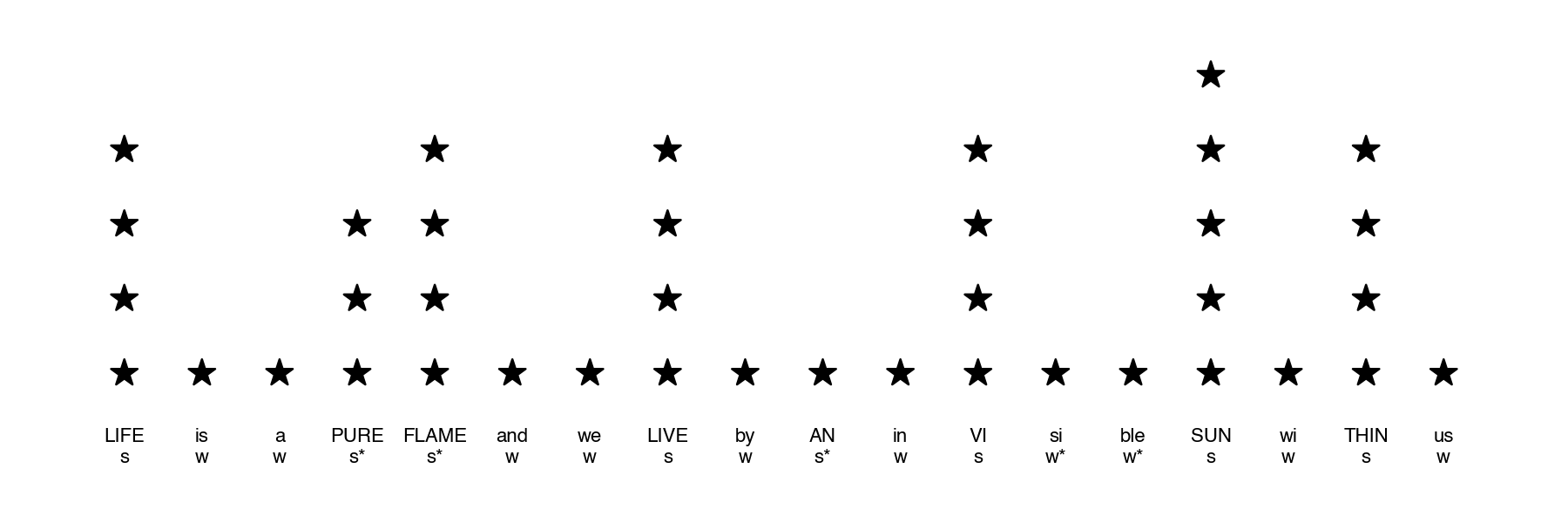
line.grid_plot(): the same grid as a figure — sun carries the sentence.
The trees behind the numbers
Those prominence values fall out of a metrical-tree computation (Dozat’s MetricalTree, run over spaCy dependency projections — lineage and validation on the methods page). text.syntax_trees() exports the projection trees themselves as nltk.Tree objects, one per sentence, with preterminals labeled TAG/tstress — and with svgling installed they render as SVG:
jack = prosodic.Text("This is the house that Jack built.", syntax=True)
tree = jack.syntax_trees()[0]

import svgling
svgling.draw_tree(tree)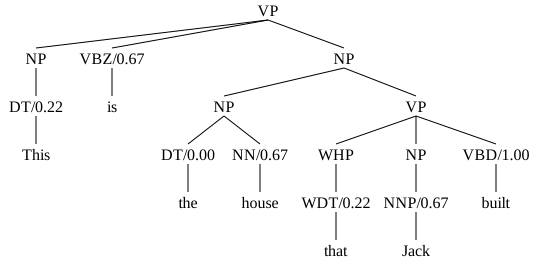
Two things to notice. The object NP has an inner core: the house is wrapped in its own NP inside NP(NP(the house) VP(that Jack built)), exactly the constituency topology the projection rules reconstruct (the relative clause wins the Nuclear Stress Rule, but the demotion lands on the inner NP node, so house keeps its local strength). And the tstress labels are the grid’s phrasal rows in tree form: built at VBD/1.00 is this sentence’s nuclear stress — the word a grid would draw tallest.
Verse vs prose, quantitatively
Now cadence’s question proper. Parse Shakespeare’s sonnets (2,155 lines) and our three prose passages with the same meter and the same phrase-sized units, and compare how well their best parses fit the alternating template. The measure: constraint violations per syllable in each unit’s best parse.
_rel = Path('corpora') / 'corppoetry_en' / 'en.shakespeare.txt'
_root = next((p for p in [Path.cwd(), *Path.cwd().parents]
              if (p / _rel).exists()), None)
corpus_fn = (str(_root / _rel) if _root else
             'https://raw.githubusercontent.com/quadrismegistus/prosodic'
             '/master/corpora/corppoetry_en/en.shakespeare.txt')

def unit_rates(text):
    """Per-linepart best-parse stats from the DataFrame parse path."""
    df = text.get_parsed_df(parse_unit='linepart')
    best = df[df.is_best & (df.parse_rank == 1)]
    g = best.groupby('line_num').agg(nsyll=('line_syll_idx', 'size'),
                                     score=('parse_score', 'first'))
    g['rate'] = g.score / g.nsyll
    viols = (best[[c for c in best.columns if c.startswith('*')]].sum()
             / len(best) * 10)
    return g, viols

verse, vv = unit_rates(prosodic.Text(fn=corpus_fn))
sources = {}
for name, passage in [('Melville', MOBY), ('Browne', URN),
                      ('Lincoln', GETTYSBURG)]:
    g, _ = unit_rates(prosodic.Text(passage))
    sources[name] = g
_, pv = unit_rates(prosodic.Text('\n\n'.join([MOBY, URN, GETTYSBURG])))
prose = pd.concat(sources.values())

print(f"verse: {len(verse):,} phrase-units, "
      f"{verse.rate.mean():.3f} violations/syllable, "
      f"{(verse.score == 0).mean():.0%} scan perfectly")
print(f"prose: {len(prose):,} phrase-units, "
      f"{prose.rate.mean():.3f} violations/syllable, "
      f"{(prose.score == 0).mean():.0%} scan perfectly")
verse: 2,900 phrase-units, 0.108 violations/syllable, 40% scan perfectly
prose: 74 phrase-units, 0.117 violations/syllable, 27% scan perfectlyfrom plotnine import (aes, after_stat, annotate, geom_histogram, ggplot,
labs, scale_fill_manual, theme, theme_minimal)
d = pd.concat([verse.assign(medium='verse (Shakespeare)'),
prose.assign(medium='prose (Melville, Browne, Lincoln)')])
(ggplot(d, aes('rate', fill='medium'))
+ geom_histogram(aes(y=after_stat('density')), position='identity',
alpha=0.6, binwidth=0.1, boundary=0,
color='white', size=0.3)
+ scale_fill_manual(values=['#1baf7a', '#2a78d6'])
+ annotate('text', x=0.02, y=4.6, label='verse', color='#1c5cab',
ha='left', size=11)
+ annotate('text', x=0.16, y=2.5, label='prose', color='#0e7a54',
ha='left', size=11)
+ labs(x='violations per syllable (best parse)', y='density', fill='')
+ theme_minimal()
+ theme(figure_size=(7, 3.4), legend_position='bottom'))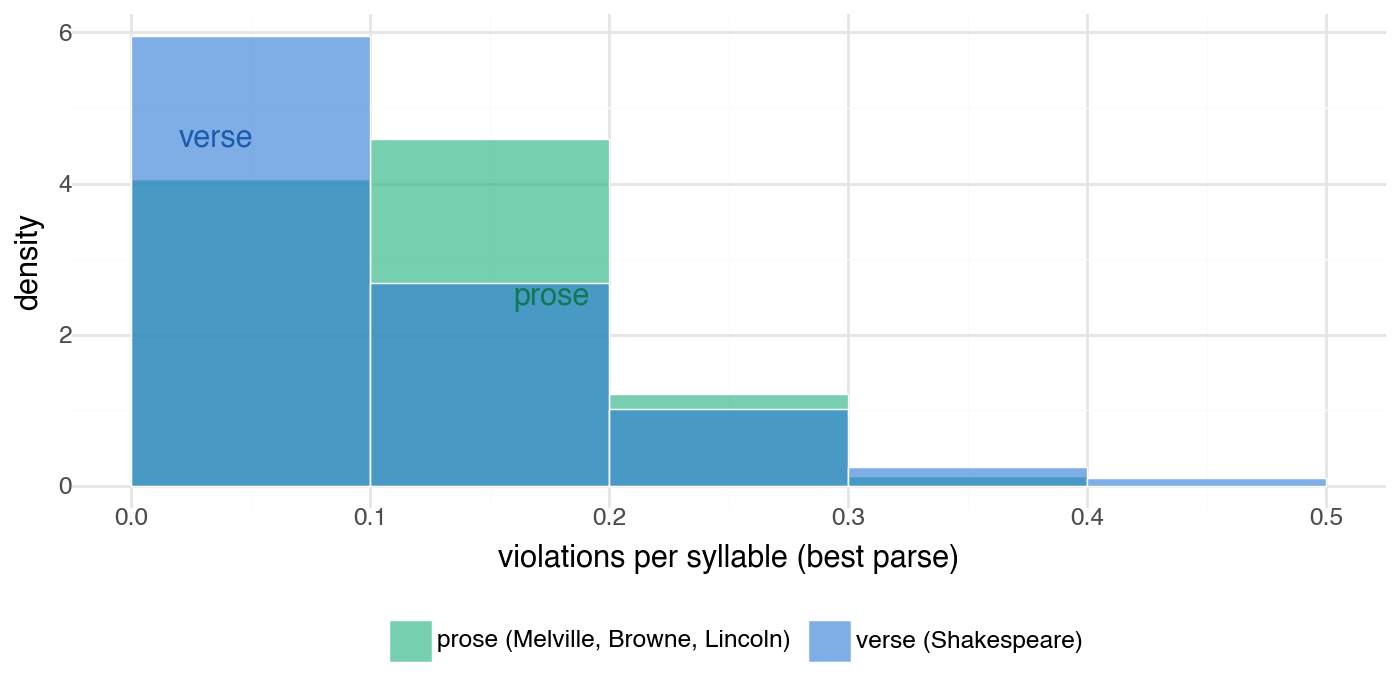
The honest headline is how close the distributions sit: 0.108 versus 0.117 violations per syllable. English phrases are already largely alternating — that is cadence’s founding observation, and why blank verse could be invented at all. The verse difference is real but specific, visible in which constraints do the discriminating:
pd.DataFrame({'verse /10 sylls': vv.round(2),
'prose /10 sylls': pv.round(2)})| verse /10 sylls | prose /10 sylls | |
|---|---|---|
| *w_peak | 0.00 | 0.00 |
| *w_stress | 0.23 | 0.09 |
| *s_unstress | 0.48 | 0.48 |
| *unres_across | 0.33 | 0.56 |
| *unres_within | 0.09 | 0.15 |
Three readings of that table. w_peak is zero in both media: given a free choice of template, best parses simply never leave a lexical stress maximum in a weak position — Kiparsky’s constraint approaches inviolability in English phrases as such, not just in verse. s_unstress is identical in both — filling every second position with a genuine stress is equally hard everywhere. Where verse actually differs is the resolution constraints (unres_across, unres_within): prose must squeeze two syllables into one metrical position roughly 70% more often. Verse’s discipline, by this measure, is less about stress placement than about syllable counting.
pd.DataFrame([
    {'source': name, 'units': len(g),
     'viols/syll': round(g.rate.mean(), 3),
     'perfect units': f"{(g.score == 0).mean():.0%}"}
    for name, g in [('Shakespeare (verse)', verse), *sources.items()]
]).set_index('source')| units | viols/syll | perfect units | |
|---|---|---|---|
| source | |||
| Shakespeare (verse) | 2900 | 0.108 | 40% |
| Melville | 24 | 0.131 | 25% |
| Browne | 17 | 0.114 | 18% |
| Lincoln | 33 | 0.108 | 33% |
And per author: the Gettysburg Address is — per phrase, by this meter — as metrical as Shakespeare’s sonnets. Lincoln’s periods were built for the ear; Browne’s long suspensions sit close behind; Melville’s roomy clauses trail. That a funeral oration out-scans Jacobean prose is the kind of thing you can only notice by counting.
What the phrasal constraints hear
All of the above used lexical stress alone. The gradient phrasal constraints (w_stress_t, w_peak_p, s_trough_p, and kin — the cadence constraint family, now fully ported) let the parser hear sentence prominence too. On fixed-template verse they add measurably nothing — but prose is their home turf, because in prose the parser must choose a rhythm, and lexical stress alone often can’t decide. Browne’s clause is a perfect tie:
LEX = ['w_peak', 'w_stress', 's_unstress', 'unres_within',
       'unres_across', 'foot_size']
PHR = LEX + ['w_stress_t', 'w_peak_p', 's_trough_p']

flame = prosodic.Text("Life is a pure flame", syntax=True)

flame.parse(meter=prosodic.Meter(constraints=LEX))
print("lexical constraints only — a dead heat:")
for p in flame.line1.parses.unbounded:
    viols = {k: v for k, v in p.viold.items() if v}
    print(f"  {p.meter_str:7s} score={p.score}  {p.txt:22s} {viols}")

flame.parse(meter=prosodic.Meter(constraints=PHR))
print("\nwith phrasal constraints — the tie breaks:")
for p in flame.line1.parses.unbounded[:2]:
    viols = {k: v for k, v in p.viold.items() if v}
    print(f"  {p.meter_str:7s} score={p.score}  {p.txt:22s} {viols}")
lexical constraints only — a dead heat:
+--++ score=1.0 LIFE is.a PURE.FLAME {'unres_across': 1}
+--+- score=1.0 LIFE is.a PURE flame {'w_stress': 1}
with phrasal constraints — the tie breaks:
+--++ score=3.0 LIFE is.a PURE.FLAME {'w_stress_t': 1, 's_trough_p': 1, 'unres_across': 1}
+-+-+ score=4.0 LIFE is A pure FLAME {'w_stress_t': 2, 's_unstress': 1, 'w_stress': 1}Lexically, demoting flame to a weak position costs exactly as much as squeezing pure flame into one strong position. But flame is a local phrasal peak with high sentence prominence — demoting it now incurs w_stress_t and w_peak_p, and the reading that keeps both nouns strong wins outright. Sometimes the phrasal evidence overturns the lexical choice entirely, as in the sentence that closes Melville’s opening paragraphs:
gazers = prosodic.Text("Look at the crowds of water-gazers there",
                       syntax=True)
gazers.parse(meter=prosodic.Meter(constraints=LEX))
print("lexical: ", gazers.line1.best_parse.txt)
gazers.parse(meter=prosodic.Meter(constraints=PHR))
print("phrasal: ", gazers.line1.best_parse.txt)
lexical: LOOK at.the CROWDS of WA ter GA zers.there
phrasal: LOOK at.the CROWDS of WA ter GA zers THERELexical stress treats final there as a demotable function word and buries it in a weak position. But there is this sentence’s nuclear stress (tstress = 1.0 — the crowds are the point, and they are there), and the phrasal constraints promote it to the final strong. That is precisely what a naturalness-ranking constraint set is for: not enforcing a template, but choosing among rhythms the way a reader would.
Coda: cadence’s question, prosodic’s answer
Is prose measurably less metrical than verse? Yes — but barely, and in one specific way. Phrase for phrase, English prose fits an alternating template nearly as well as Shakespeare (0.117 vs 0.108 violations per syllable); what verse adds is syllabic discipline (half the resolution rate) and a much larger stock of perfect phrases (40% vs 27%). The rhythm was in the language all along; meter is its concentration.
This page is cadence’s research program running inside prosodic: the linepart parser, the gradient phrasal-stress port, the pstrength peaks and valleys, the *_p/*_t constraint family, and the metrical grid all came from or through that fork (archived 2026 — superseded, which is the best thing that can happen to a fork). Related reading: Phrasal stress for the algorithm and its validation · Metrical parsing for the parser · Shakespeare’s sonnets for the verse-side companion study.