Learning each meter’s constraint weights from hand-tagged scansions: binary vs. ternary, and where in the line each meter is strict
Prosodic’s constraints are violable: a parse is scored by the weighted sum of its violations, and nothing in the machinery says iambic verse and anapestic verse must weight those constraints the same way. Metrical theory says they shouldn’t — Hanson & Kiparsky (1996) characterize English binary and ternary meters as regulating different positions (weak vs. strong). This page tests that claim empirically, and by the shortest possible route: fit a MaxEnt model to hand-tagged scansions of each meter separately, and read each meter’s grammar off the learned weights.
Everything below is computed by the code shown, on data that ships with Prosodic; the site embeds one real frozen execution.
The gold standard
data/tagged_samples/foot-gold.csv: 120 hand-tagged lines, 30 per meter, each with its per-syllable scansion (w = weak position, s = strong).
import warningsfrom pathlib import Pathwarnings.filterwarnings('ignore')import pandas as pdimport prosodicfrom prosodic.parsing.maxent import MaxEntTrainer_rel = Path('data') /'tagged_samples'/'foot-gold.csv'_root =next((p for p in [Path.cwd(), *Path.cwd().parents]if (p / _rel).exists()), None)gold_fn = (str(_root / _rel) if _root else'https://raw.githubusercontent.com/quadrismegistus/prosodic''/master/data/tagged_samples/foot-gold.csv')gold = pd.read_csv(gold_fn)METERS = ['iambic', 'trochaic', 'anapestic', 'dactylic']gold.meter.value_counts()
for m in METERS: r = gold[gold.meter == m].iloc[1]print(f"{m:10s}{r.scansion:16s}{r.line}")
iambic     wswswswswsws     Thy skill to poet were, thou scorner of the ground!
trochaic   swswswswswsw     Not a cell is left the God, no roof, no cover
anapestic  wswwswwsw        What bud was the shell of a blossom
dactylic   swwswwswwswwswwsw He must forsooth make a fuss and distend his huge Wittenberg lungs, and
Fit a grammar per meter
MaxEntTrainer parses every line, matches the annotated scansion among the parser’s candidates, and learns the constraint weights that make the annotation maximally probable (L-BFGS-B; Goldwater & Johnson 2003). The loader takes the CSV’s line/scansion columns directly, and mixed-syllable-count lines — the gold’s elisions, like heav’n and trav’ling — train like any others.
weights = {}for m in METERS: tr = MaxEntTrainer(prosodic.Meter(), regularization=1.0) tr.load_annotations(gold[gold.meter == m]) tr.train() weights[m] = tr.learned_weights()W = pd.DataFrame(weights).round(2)W
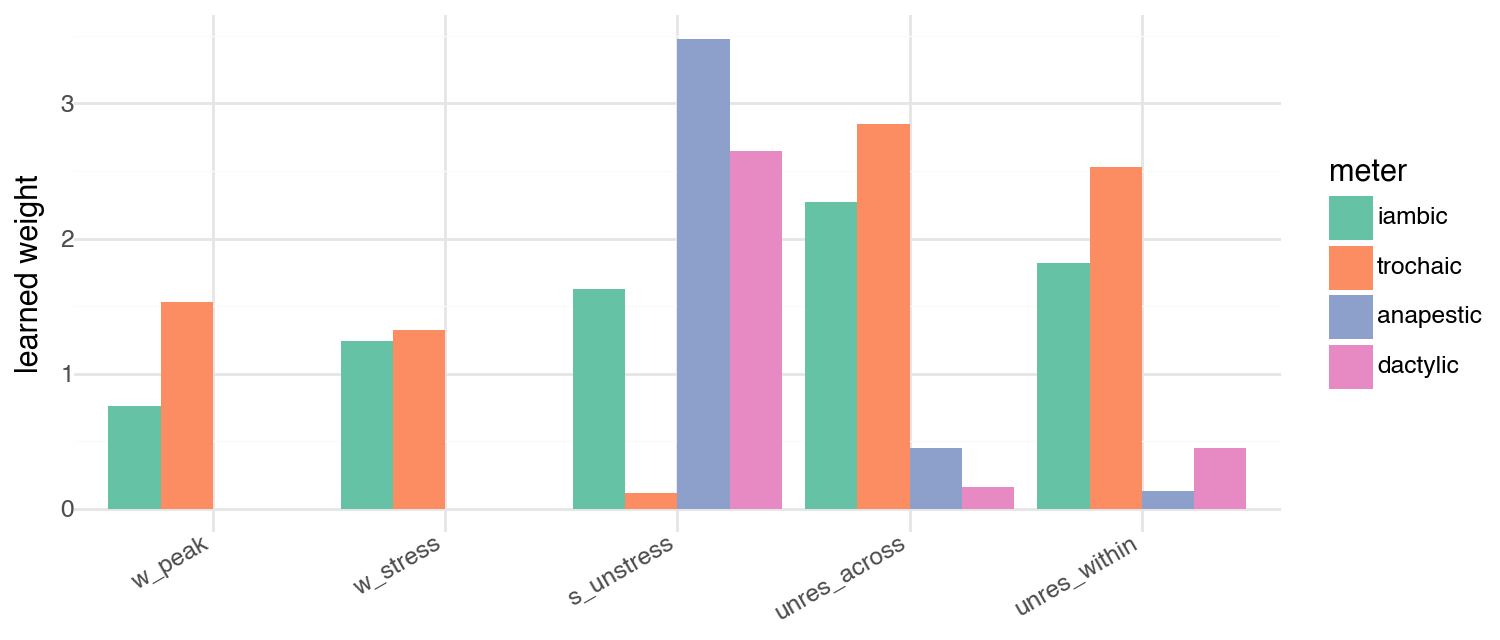
Figure 1: Each meter’s learned grammar. Binary meters (iambic, trochaic) weight the weak-position constraints; ternary meters (anapestic, dactylic) zero them and regulate the strong positions instead.
The split is categorical, and it is Hanson & Kiparsky’s parameter recovered from thirty lines per meter:
Binary meters police the weak positions.w_stress and w_peak (no stress, no lexical peak, off the beat) carry real weight, and the unres_* constraints (no two syllables sharing a position) are the strictest of all — binary positions are monosyllabic.
Ternary meters police the strong positions.w_stress and w_peak drop to zero — a stressed monosyllable sits freely inside an anapest’s double-weak dip (“the blue wave rolls nightly”) — while s_unstress (every beat must be stressed) becomes the heaviest weight in any grammar, and disyllabic positions are of course tolerated.
Where in the line is each meter strict?
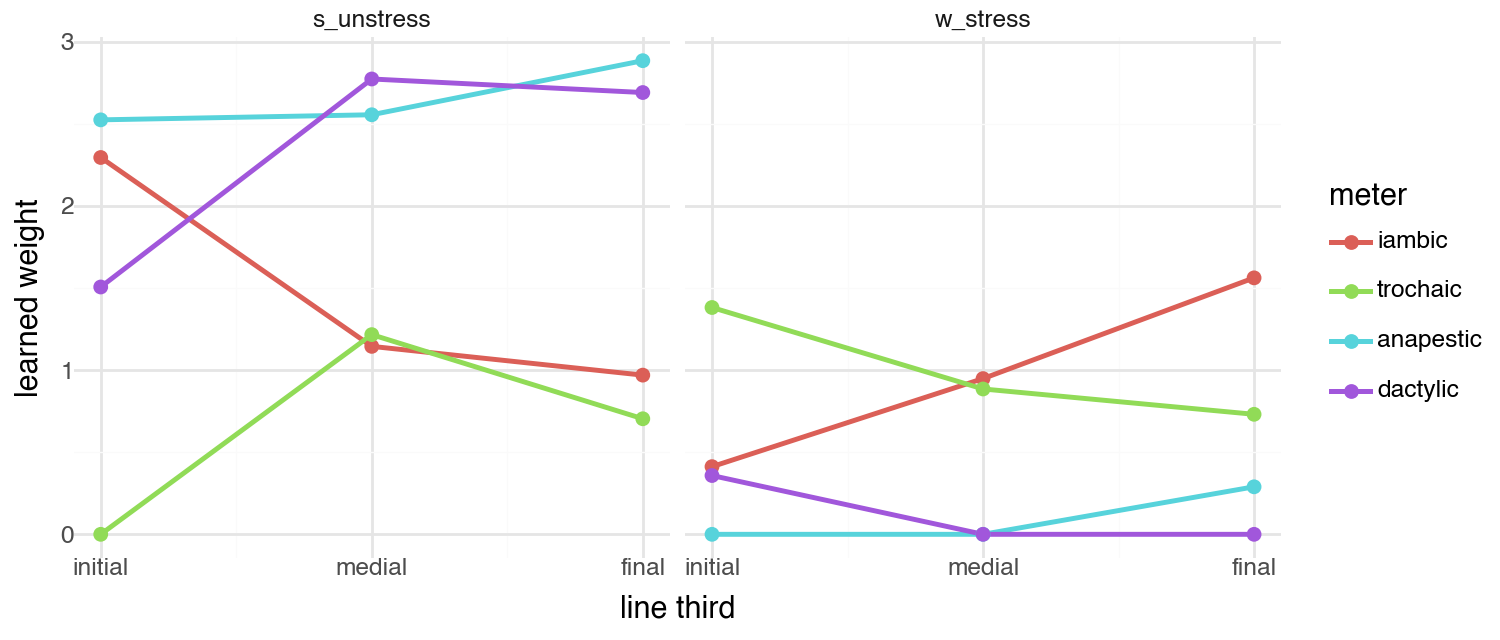
Splitting each constraint’s weight by line thirds (zones=3) asks a finer question: not just which positions a meter regulates, but where along the line.
rows = []for m in METERS: tr = MaxEntTrainer(prosodic.Meter(), regularization=1.0, zones=3) tr.load_annotations(gold[gold.meter == m]) tr.train()for name, wt in tr.learned_weights().items(): base, z = name.rsplit('_z', 1)if base in ('w_stress', 's_unstress'): rows.append(dict(meter=m, constraint=base, zone=int(z), weight=wt))Z = pd.DataFrame(rows)Z.pivot_table(index=['constraint', 'zone'], columns='meter', values='weight').round(2)[METERS]
Figure 2: Constraint weight across line thirds. The strict edge flips with headedness: iambic locks its line-final beat, trochaic its line-initial one.
The flat fit cannot see this: the strict edge flips with headedness. Iambic verse — rising, final-headed — enforces w_stress most strictly in its final third: the line may open with an inversion (“Pity the world…”), but its last beat is inviolable. Trochaic verse is the exact mirror: strictest at the opening, loose at the close (where feminine endings and truncations live). The ternary meters show the complementary picture in s_unstress: every beat must be stressed, increasingly so toward the line’s end.
Two cautions, in the spirit of reading a regression honestly. A low weight means the annotated parses don’t differ from their competitors on that constraint — non-discriminative is not the same as permitted. And thirty lines per meter is a pilot’s sample: the shape of the signature is robust (it survives a tenfold change in regularization), but individual decimals are not.
Reproducing and extending
The full study lives in scripts/maxent_by_meter.py, which adds two analyses omitted here: a coverage audit of which gold lines train (all of them, since mixed-syllable-count elision lines were made trainable), and a partial-pooled joint model — one shared grammar plus per-meter deviations — where the binary/ternary split appears as opposite-signed deviations from the shared mean. Theory and the corresponding section: Metrical parsing; the annotation format: Foot parsing.